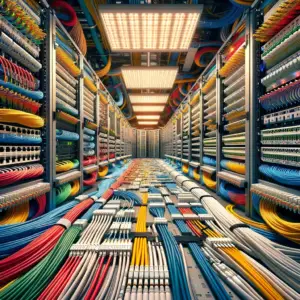
Unlocking the Power of Computer Networks
Computer networking revolutionizes how computers communicate, enabling data exchange and enhancing connectivity across devices. Simplified, a computer network links two or more computers through various mediums—wired or wireless—to facilitate seamless data sharing.
Core Elements of a Computer Network
- Nodes and Links: At its simplest, networks consist of nodes (computers, routers, switches) connected by links (cables or wireless signals).
- Protocols: These are the essential rules enabling devices to communicate, ensuring data is sent and received correctly across the network.
Understanding Network Basics
- IP Address: Each device on a network has a unique identifier, the IP address, ensuring precise data delivery.
- DNS: The Domain Name System translates human-friendly domain names into IP addresses, simplifying our interaction with websites.
- Firewall: Acting as a security guard, a firewall controls network traffic, blocking unauthorized access to maintain network integrity.
Network Types Explained
- LAN (Local Area Network): Ideal for small geographical areas like homes or offices, providing high-speed connections among nearby devices.
- WAN (Wide Area Network): Spans larger areas, connecting networks across cities or countries, facilitating long-distance communication.
- Cloud Networks: These flexible networks leverage cloud computing to offer scalable and on-demand network services.
Diving Deeper: Network Architectures
- Client-Server: A robust structure where servers provide resources or services to client computers.
- Peer-to-Peer (P2P): A decentralized model allowing direct data exchange between devices without a central server.
Key Networking Devices
- Routers and switches facilitate data routing and network connectivity, playing pivotal roles in managing network traffic.
- Hubs and bridges also contribute by connecting multiple network segments, enhancing the communication between devices.
Decoding Network Topologies
Network topology refers to the layout pattern of nodes in a network. Popular topologies include:
- Star: Centrally managed and highly reliable.
- Mesh: Offers a high level of redundancy, with each node connected to multiple others.
- Ring: Each node connects to two others, forming a circular data path.
The OSI Model: A Layered Approach
The Open Systems Interconnection (OSI) model is a seven-layer framework that standardizes network functions to support interoperability between different systems and technologies.
- Physical Layer: Concerns with hardware connections.
- Data Link Layer: Manages node-to-node data transfer.
- Network Layer: Handles data routing across multiple networks.
- Transport Layer: Ensures reliable data transfer.
- Session Layer: Manages sessions between applications.
- Presentation Layer: Translates data formats.
- Application Layer: Interfaces with end-user applications.
Enhancing Network Security
In the era of digital expansion, securing network infrastructure is paramount. Employing robust firewalls, secure protocols, and vigilant monitoring can safeguard against threats, ensuring data integrity and privacy.
Future-Proofing with IPv6
With the internet’s exponential growth, the newer IPv6 offers a vast address space, accommodating the burgeoning number of devices, thereby future-proofing networks.
Navigating Through Ports and Protocols
Ports serve as communication endpoints, with specific port numbers designated for particular services (e.g., HTTP on port 80). Understanding ports and their associated protocols is crucial for network configuration and security.
Conclusion: The Gateway to Connectivity
Grasping the basics of computer networking opens up a world of possibilities, from enabling simple file sharing to facilitating complex cloud-based services. As technology evolves, understanding these fundamentals becomes essential for leveraging the full potential of digital connectivity.
Whether you’re a budding enthusiast or a seasoned professional, the journey into computer networking promises a fascinating exploration of how we connect and communicate in the digital age.